
Sedgwick County Criminal Court Records
The DC18 Criminal Department files and maintains criminal actions in Sedgwick County District Court. Its work includes felony and misdemeanor cases, fish and game matters, appeals from municipal court, search warrants, and inquisitions. The department receives and disburses money as ordered by the court and interacts with attorneys, the public, and government agencies. Research notes say about 3,000 criminal cases per year are filed in that office.
These criminal court records are case-level files. They differ from the arrest-to-charge material discussed in Sedgwick County arrest records and court charges. A police arrest or jail booking can exist before any prosecutor files a court case. The criminal court record begins to matter most once a complaint, information, indictment, municipal appeal, warrant matter, or other criminal filing enters the court system and is tracked by the Clerk of the District Court.
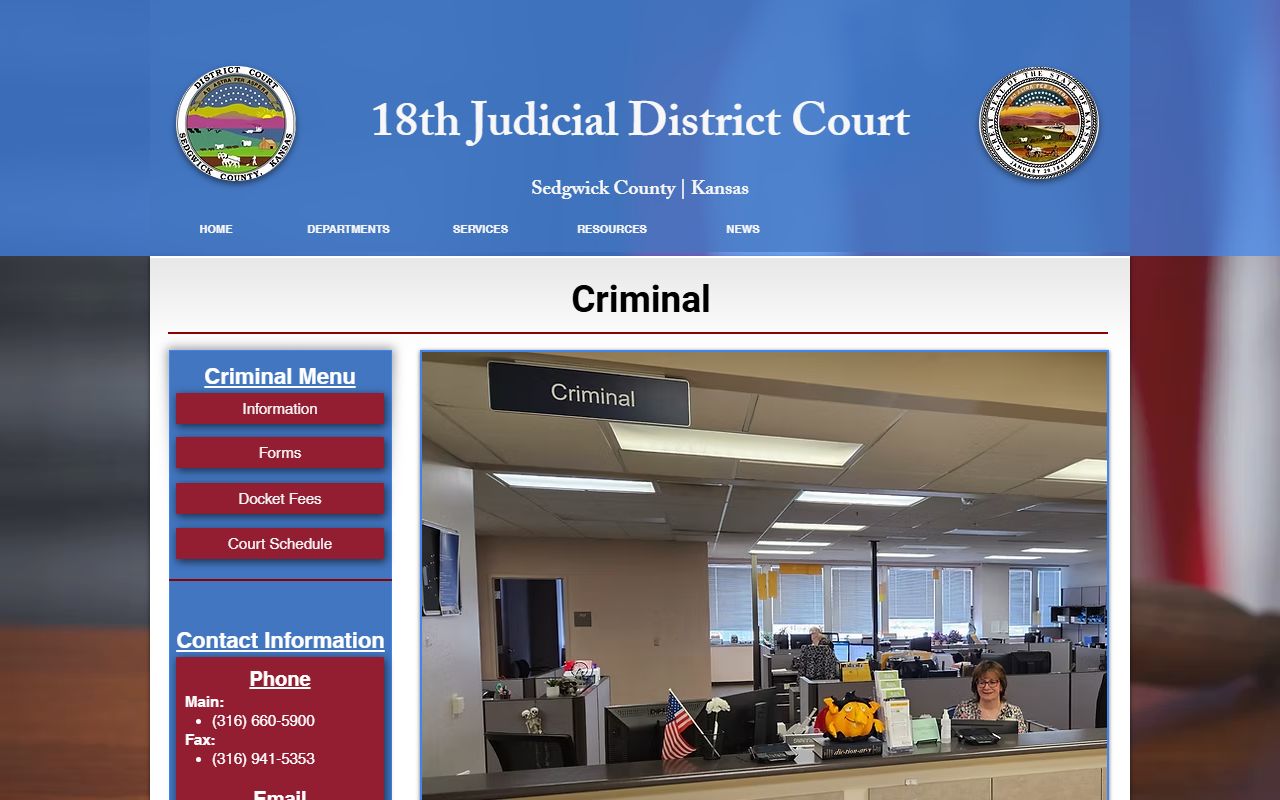
The DC18 Criminal Department source identifies the local District Court office for Sedgwick County criminal court records.
Search Sedgwick County Criminal Cases
For District Court criminal case files, start with Kansas CaseSearch through the DC18 Records Department route. DC18 says public users can search by party name or case number and must complete a robot check. Criminal matters that do not appear online may still be available through public terminals, a written request, or a staff-assisted archived search. Copies and certified records should be requested from the Clerk of the District Court, Records Department.
- Confirm whether the matter is District Court or Wichita Municipal Court. City ordinance and city traffic cases may be in WebCourt.
- Search CaseSearch by defendant name or case number for District Court criminal records.
- Review the docket entries for charges, hearings, motions, pleas, disposition, and sentencing activity.
- Use the DC18 Records Department if the case is archived, absent from the portal, or needs copies.
- For Wichita city cases, use Wichita WebCourt and the Municipal Court customer-service routes.
Search results are not a complete criminal-history report. A public court file can show charges that were dismissed, amended, or not yet resolved. For current custody, the sheriff inmate search is a different system. For active warrants, the sheriff and Wichita Municipal Court have separate warrant tools. For all court case categories beyond criminal files, use the broader Sedgwick County court records access route.
The Sedgwick County District Attorney source connects criminal prosecution work to District Attorney Marc Bennett's office.
Sedgwick County Criminal Case Flow
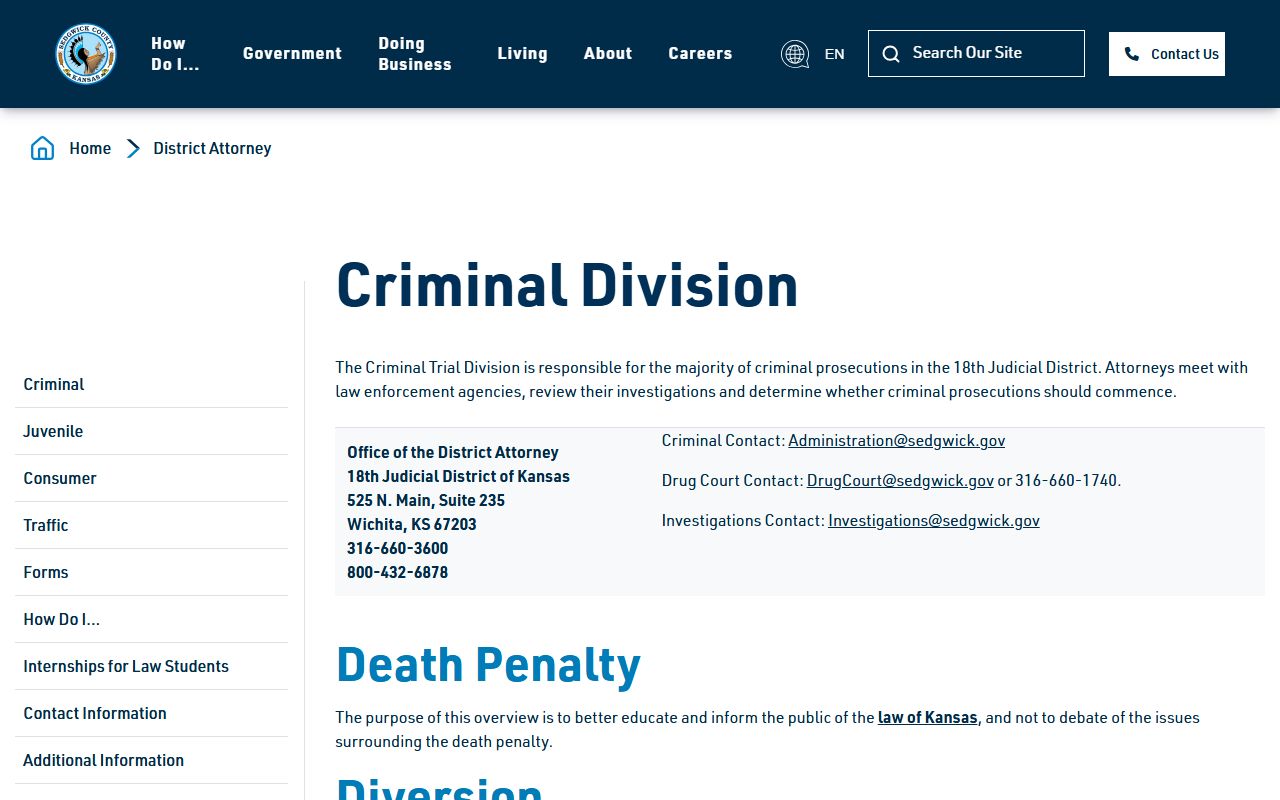
A criminal court record is built in stages. The DA Criminal Division says attorneys meet with law enforcement agencies, review investigations, and determine whether criminal prosecutions should commence. Once the court case exists, the docket may show the charging document, arraignment, pretrial settings, motions, plea negotiations, trial dates, verdict, disposition, and sentencing. Not every case reaches each stage. Some are dismissed, diverted, amended, appealed from municipal court, or resolved by plea.
Case flow: Charges Filed › Arraignment › Pretrial / Motions › Plea or Trial › Disposition › Sentencing
| Stage | What Happens |
|---|---|
| Charges Filed | The prosecutor or court filing starts the criminal case record and creates a case number. |
| Arraignment | The defendant is advised of the charge and a plea may be entered or scheduled. |
| Pretrial / Motions | The docket can show hearings, motions, orders, bond matters, and attorney appearances. |
| Plea or Trial | The case is resolved by plea, trial verdict, dismissal, amendment, or another court action. |
| Disposition | The outcome is entered for the case or charge, such as guilty, dismissed, acquitted, or diverted. |
| Sentencing | If there is a conviction, the record may show jail, prison, probation, fines, costs, restitution, or other terms. |
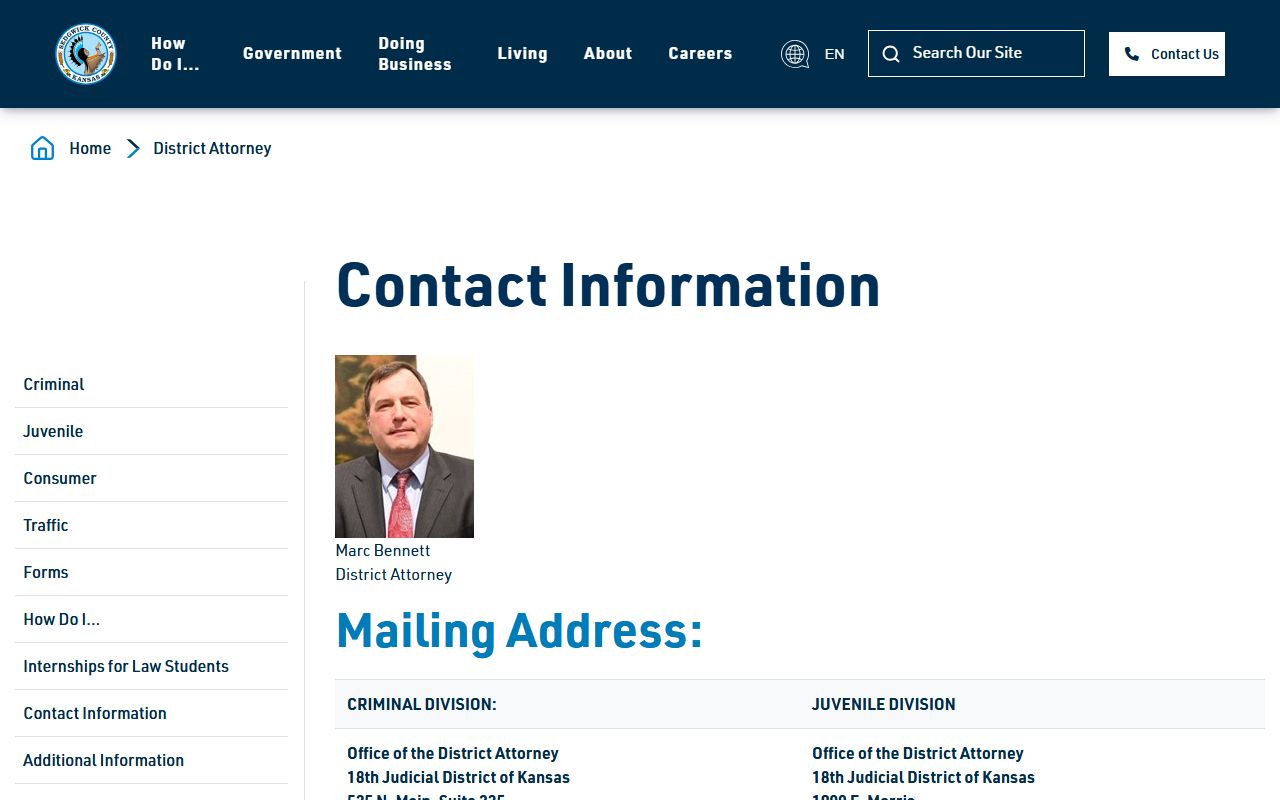
The District Attorney contact source provides Sedgwick County criminal and juvenile division contact details.
Sedgwick County Criminal Record Fields
Criminal court records in Sedgwick County can combine search fields, docket entries, and case file content. The research supports fields such as case number, case type, party names, attorney names, filing date, date opened or closed, court or division, judge, status, docket events, hearings, pleadings, orders, judgments, costs, fines, restitution, bond, warrant entries, sentencing, disposition, and document security. Wichita WebCourt confirms municipal search fields such as name, case number, citation, arresting case number, driver's license number, date ranges, date of birth, court types, case types, party types, and CAPTCHA.
| Field | What It Shows |
|---|---|
| Case Number | The court identifier used to track the criminal file, docket, copies, and hearings. |
| Defendant | The person charged in the criminal case, with party details limited by court rules. |
| Charges | The alleged offense or offenses as filed, amended, dismissed, or otherwise changed in court. |
| Plea | The defendant's formal response, such as guilty, not guilty, or another court-accepted plea. |
| Motions and Orders | Requests by parties and written rulings or directions entered by the judge. |
| Disposition | The final outcome for a charge or case, including dismissal, conviction, acquittal, or diversion result. |
| Sentence | Post-conviction terms such as confinement, probation, fines, costs, restitution, or conditions. |
| Security | Whether an event or document is public, sealed, confidential, legacy-secured, or unavailable online. |
Charges vs Convictions
A filed charge is an accusation in a criminal court record. A conviction is a later outcome based on a plea or verdict. Sedgwick County criminal court records may show both, but they should not be read as the same thing. The DA Criminal Division reviews investigations and determines whether prosecutions should commence, while the court record later shows how the filed charge moved through hearings and disposition.
| Charge | Conviction | |
|---|---|---|
| Meaning | An accusation filed into a criminal case. | A finding or plea establishing guilt. |
| Record Stage | Appears near the start and may be amended, reduced, or dismissed. | Appears after plea, verdict, or other final outcome. |
| Use | Shows what was alleged by the prosecution. | Shows the adjudicated result and may connect to sentencing. |
| Caution | A charge alone is not proof of guilt. | A conviction may still be subject to appeal, expungement, or later orders. |
The District Attorney Criminal Division source explains prosecutorial review in Sedgwick County criminal cases.
Sealed and Expunged Records
Public criminal court record access is broad, but it is not unlimited. DC18 excludes arrest-expungement case types and confidential or sealed documents from public portal access. It also excludes certain case categories from public view, including juvenile CINC, juvenile offender, grand jury, inquisitions, material witness, domestic, protection, and other sensitive matters. K.S.A. 21-6614 controls expungement for certain criminal convictions, arrest records, and diversion agreements.
| Sealed | Expunged | |
|---|---|---|
| Public Visibility | Hidden from ordinary public access by law, rule, or court order. | Limited from public lookup after a granted expungement order. |
| How It Happens | Can be set by statute, document security, or court order. | Usually requires a petition in the court where the case occurred. |
| Who May See It | Parties, attorneys, agencies, or others allowed by law or order may have access. | Law enforcement or other limited statutory users may still have exceptions. |
| Practical Step | Contact the court if you are a party or have legal authority to request access. | Keep certified copies of the expungement order because systems may update at different speeds. |
Juvenile and child-in-need-of-care files are also restricted under Kansas law. A public portal search should not be expected to show those records. Party access, attorney access, or a court order may create a different route, but the request still belongs with the court.
Sedgwick County Defense Counsel
Defense counsel context can help users understand why attorney names appear in criminal court records. The Kansas State Board of Indigents' Defense Services provides defense counsel through the public defender system or assigned counsel program. The Sedgwick County Public Defender Office is listed at 604 N. Main St., Suite D, Wichita, KS 67203, phone 316-264-8700. The Sedgwick County Conflicts Office is listed at 266 N. Main St., Suite 210, Wichita, KS 67202, phone 316-267-1847.
Those offices are not general records offices. They belong in the court ecosystem because public defender or conflict counsel may appear as attorneys of record, but copies and certified criminal court records should be requested from DC18 or searched through CaseSearch when public. Private defense counsel, prosecutors, and court staff may have different access rights than general public users.
The Kansas State Board of Indigents' Defense Services source explains the public defender and assigned counsel system.

The Sedgwick public defender contact source lists local defense offices connected to Sedgwick County criminal court records.

Public Criminal Court Access
Kansas open-record rules and court-access rules both matter for Sedgwick County criminal court records. K.S.A. 45-216 states the public policy favoring open records. K.S.A. 45-218 covers inspection and copy requests. K.S.A. 45-221 lists exemptions. For electronic court files, Kansas Supreme Court Rule 106B and Rule 24 shape public access and redaction.
Note: Criminal court records are public only to the extent allowed by Kansas statutes, court rules, and case-specific sealing orders.
For in-person or written requests, use the Clerk of the District Court Records Department at the Sedgwick County Courthouse, 525 N. Main Street, 6th Floor, Wichita, KS 67203. The Records Department phone is 316-660-5900, fax 316-941-5358, and records email is sg.micro@kscourts.gov. Public terminals are available for viewing public records, while copies, certification, and archived searches may require fees and prepayment.